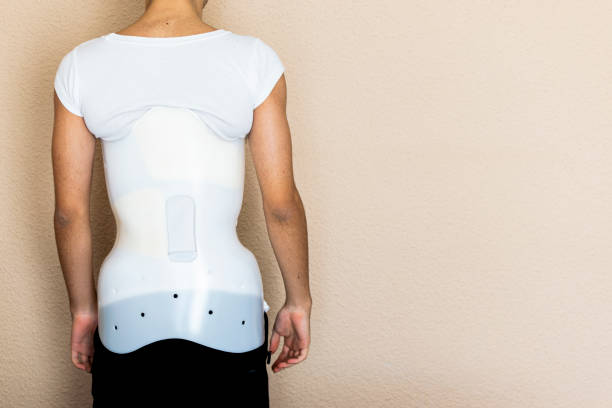
Back bracing is typically recommended for children who are still growing and who have a moderate curvature (higher than 25 degrees). The primary goal of bracing is to prevent the spinal curvature from progressing as the patient ages–some patients can even achieve curve reduction through bracing. To determine if back bracing will be effective on a child, a doctor will likely take an x-ray of the child’s growth plate to see if it has closed or not. If the growth plate is not closed, that means the child is still growing, thus back bracing could be an effective treatment option for slowing down the progression of their spinal curvature. However, if the child’s growth plate is closed, that means they have stopped growing and back bracing will likely not be an effective treatment option.
The time that a back brace is recommended to be worn differs from person to person. Typically, people with moderate scoliosis are recommended by their doctors to wear their brace between 12 to 23 hours a day. To determine the specific length of time a person will need to wear their brace, the doctor will consider their unique growth pattern. My favorite analogy is that scoliosis bracing is like medicine: it only works if you use it like prescribed. To maximize the benefits from your brace, it is imperative that you wear it for the recommended amount of time each day.
The primary goal of a scoliosis brace is to prevent a person’s spine from becoming more curved as they grow. A brace is molded to hold a person’s spine in a straight, unrotated position–it does this by putting pressure on the outer edges of a person’s curvature. The most common type of scoliosis brace is the Boston Brace 3D. This is a vest-style brace that is made of lightweight plastic that closes in the back. Like it’s name suggests, this brace was developed at the Boston Children’s Hospital in the 1970’s. Another type of back brace is the Rigo-Cheneau Brace. This brace is specialized in helping de-rotate the spine.
 The Spine Saga